I've got an almost unhealthy interest in editors. So here's a page listing all the editors for various games, and notes about them.
Preditor (Prey, 1995-1998)

Prey's editor, Preditor. A screenshot taken from the viewport.
An obvious one for me to start off with is the Preditor tool developed for 3D Realms' Prey.
Having spoken in the past with Matt Wood that worked with the editor, it was described as being incredibly powerful and similar to SketchUp.
As far as I've been able to discern, the user plots their polygon in a viewport (either 2D or 3D) and a brush is then produced from that.
Rather than maps or levels, you've got individual rooms, and each room connects to another room via a portal.
Supposedly Max Payne's level editor is based on Preditor, or at least inspired by it, and it shows when comparing it against screenshots and other things we know of Prey's editor. Though Prey's environments were additive to my knowledge, while Max Payne's are subtractive.
More screenshots are available here.
UnrealEd (1995-)
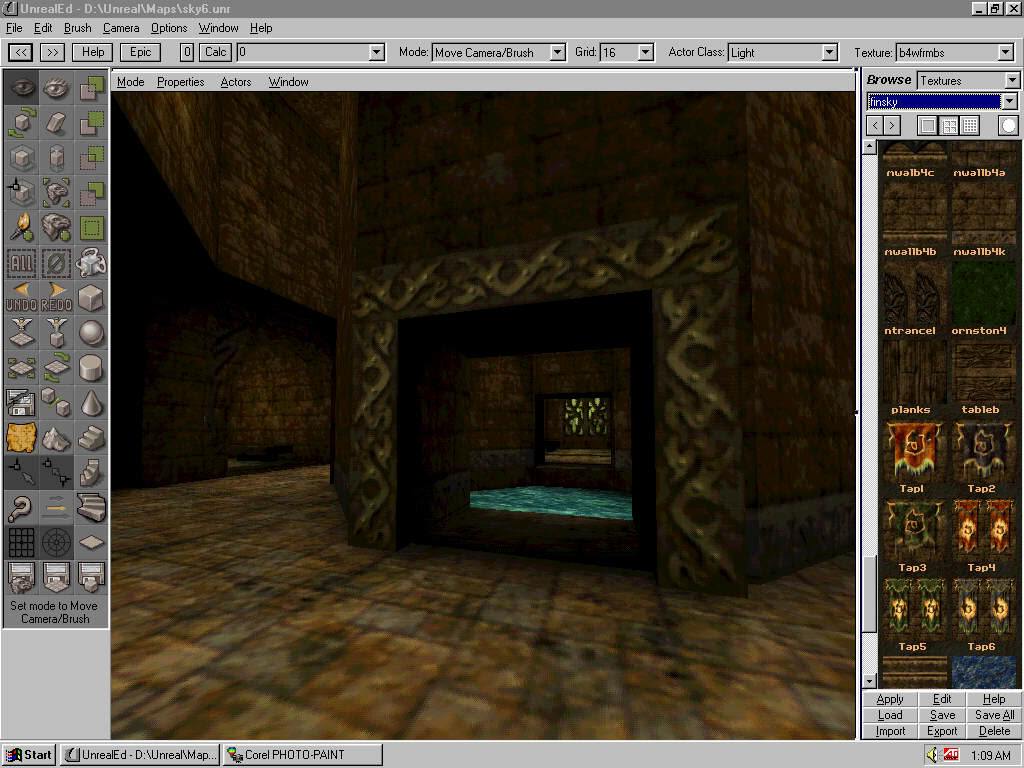
The Visual Basic version of UnrealEd.
I don't think I'll need to say much about this, will I?
It was eventually rewritten in C++ for Unreal Tournament and got a bit of a makeover. This was carried over into the Unreal Warfare and Unreal Engine 2+ iterations of the engine. Though the original icons still do something for me.
For Unreal Engine 3, it was rewritten again using wxWidgets (or wxWindows, as it was called at the time). I'm not really sure what the idea behind this move was, perhaps there was some interest in making the editor multi-platform? Though that never happened if it was the case.
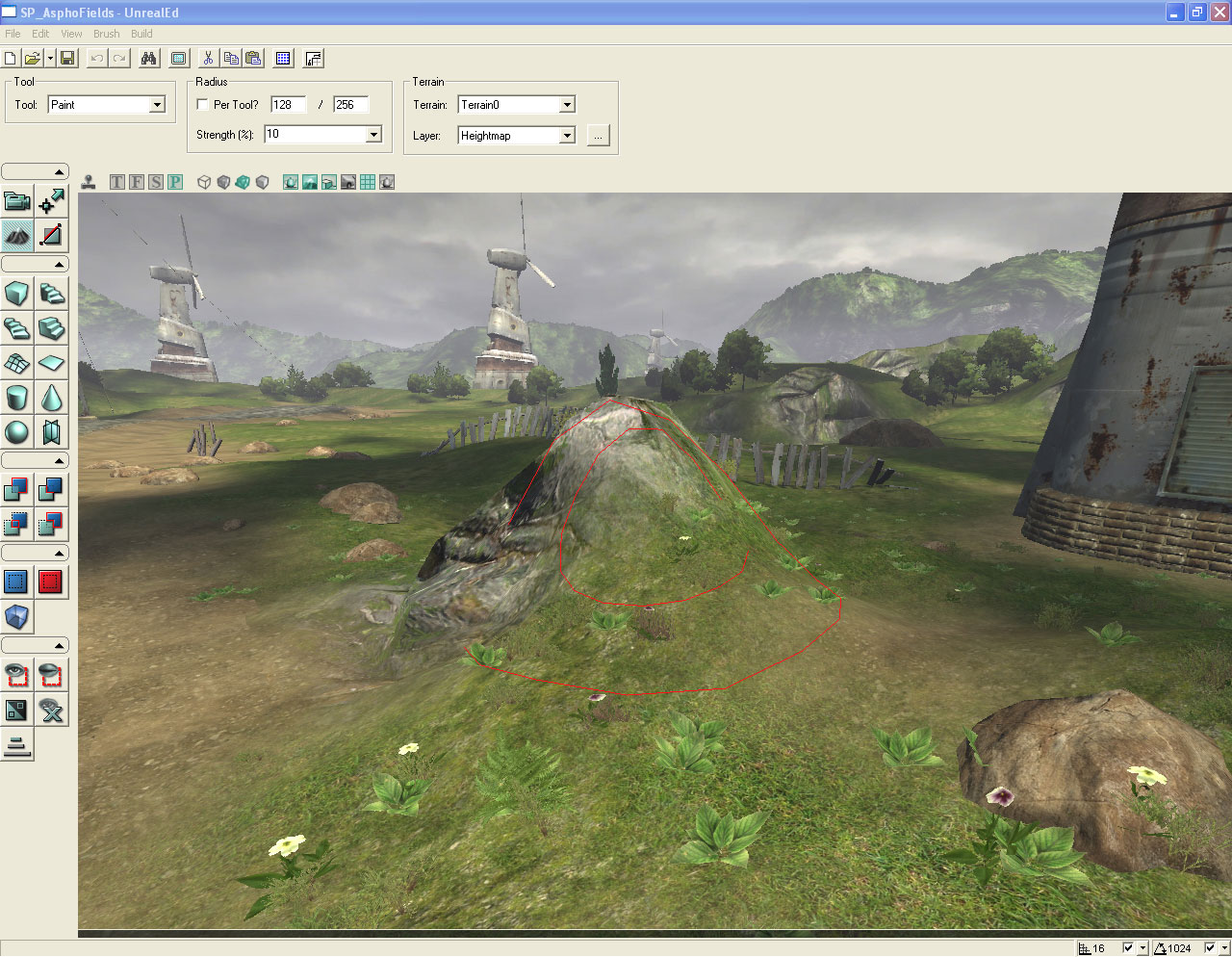
Unreal Engine 3's UnrealEd, using wxWidgets.
This eventually evolved into the UDK; Unreal Development Kit.
For Unreal Engine 4, they pretty much rewrote it again using their own UI framework called Slate and it gets a little boring from there.
Sandbox (Duality, 1998)
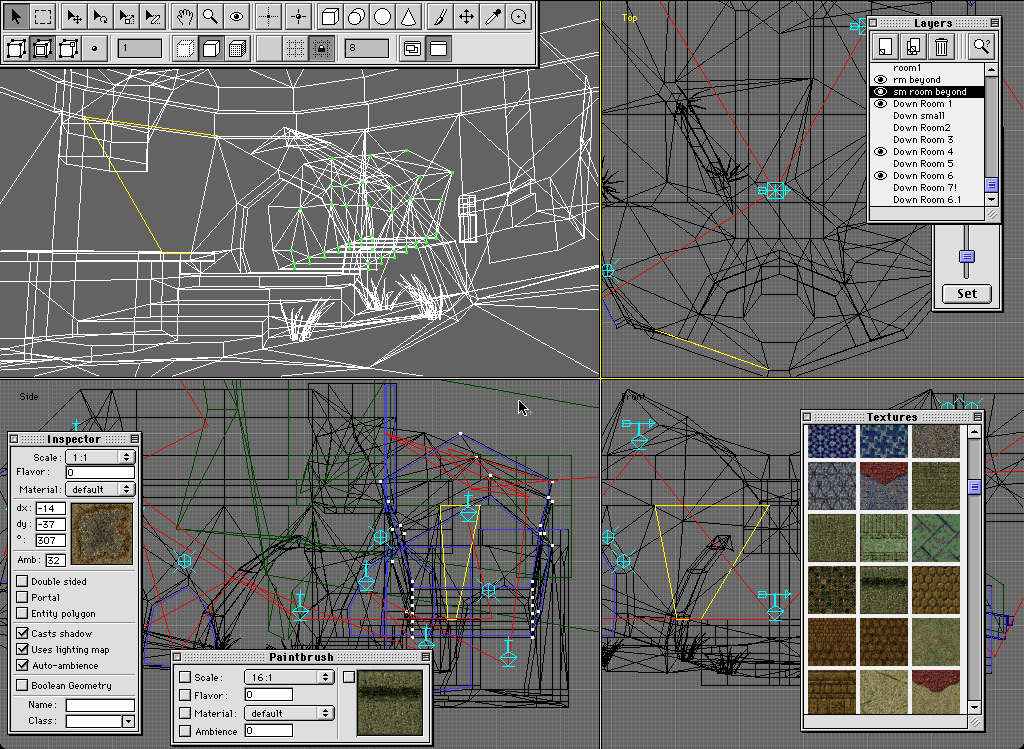
Duality's editor, Sandbox.
Duality is a cancelled game that was being developed by Double Aught. Environments seem entirely polygonal, and the geometry appears to be modelled in the editor like you would with a 3D modelling app. So essentially, no brushes like in some other editors.
Portals are used for visibility culling. These can be seen in the 2D views per the purple/blue wireframe. One assumes that when these are placed, it just immediately treats geometry on one side as room A and the other as room B. This was probably pretty easy to implement given their levels are just polygon soup.
The yellow highlighted polygon appears to be the current selection, and the inspector on the bottom left is showing the properties for it. You can see there that surfaces could be marked as portals, double-sided, ambient light level could be set (per "Amb"), X Y and rotation for the texture, and more. There's also a checkbox for boolean geometry, so evidently I guess the editor supported CSG to some extent.
The texture browser on the right seems very primitive with just a list of icons. No names, sizes or anything like that, oddly enough.
On the top right we can see there's also a layer browser. This is pretty nifty from the looks of it, and it seems parts of the level could be tied to a layer which the level designer could then toggle visibility for to presumably make their work easier. Per other screenshots, the levels look massive, so it's probably not too surprising they implemented this—it might be the first 3D level editor that had layers, at least to my knowledge.
You can find more screenshots here.
Seed (1998-1999)
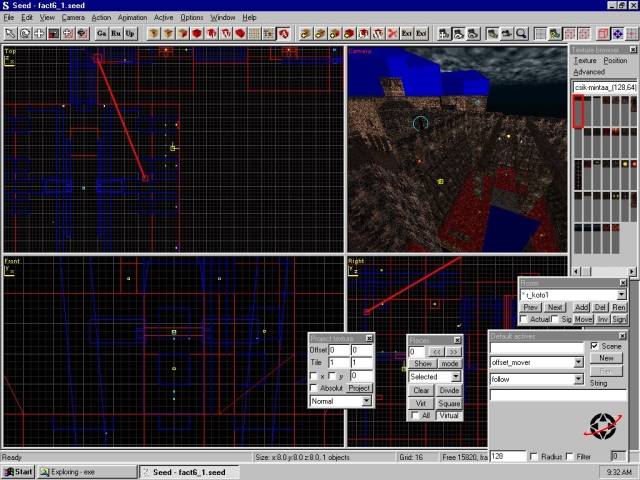
Apparently Seed's editor is called... Seed?
Looks very similar to Hammer/Worldcraft. Very likely an additive workflow.
Along the toolbar at the top, you can see some cubes that look like vertex selection, edge selection, face selection and brush selection modes? It's unfortunately very hard to make out many of the icons.